Supongo que si uno ha estudiado árabe y persa, desembocar en el turco, y en especial en el otomano (
Osmanlı Türkçesi,
Osmanlıca, عثمانليجه —o لسان عثمانى según
el germen de Wikipedia otomana—), es sólo cuestión de tiempo. Yo mismo, sin ir más lejos, de mi primera, y por ahora única estancia en Turquía volví con la
Osmanlıca Rehberi de Ali Kemâl Belviranlı, las
Osmanlıca Dersleri en 2 volúmenes de Yılmaz Kurt, el
Redhouse y el
Osmanlıca-Türkçe Ansiklopedik Lûgat de Ferit Devellioğlu, aunque reconozco que no he pasado de hojearlos, picoteando aquí y allá, y soñando con poder hincarles el diente algún día. No obstante y como quiera que la esperanza es lo último que se pierde, a ese
hojeo tradicional he sumado el
web'e gözatma, y de vez en cuando navego también por sitios dedicados a la lengua otomana que, como casi todo en Internet, son cada vez más numerosos y
sofisticados.
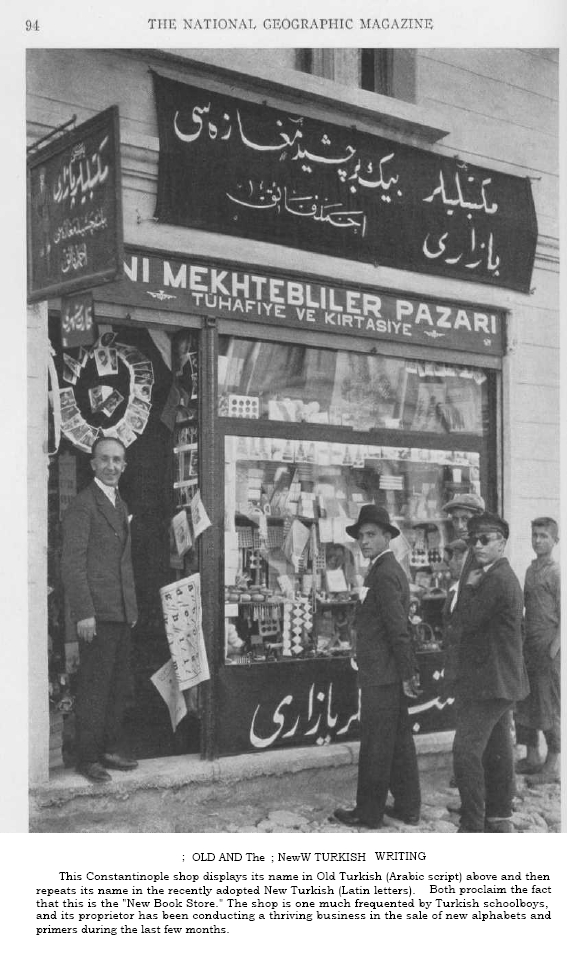
Maynard Owen Williams, "Turkey goes to school", The National Geographic Magazine, January, 1929. (Paradójicamente mekhtebliler, 'escolares', no se corresponde con su escritura actual: mektepliler.)
Y así, hojeando y ojeando, comenzó a llamarme la atención cómo de un tiempo a esta parte la cuestión del otomano ha pasado no sólo del ámbito estrictamente académico al público, en consonancia con lo que algunos consideran un
retorno del otomanismo o
neo-otomanismo, auspiciado por el
Partido de la Justicia y el Desarrollo (
Adalet ve Kalkınma Partisi, AKP) en el poder, sino más concretamente al religioso, no sin chocar de lleno con las
fuerzas laicas del país. Como mi turco no da para mucho, véase, p. ej., este artículo de Jonathan Gorvett publicado en 2004 en el sitio en inglés de Aljazeera:
"Ottoman script sparks war of words".
Después de todo, tal vez sea éste el mejor momento para aprender turco otomano ("a río revuelto..."), antes de que los
kemalistas lo proscriban definitivamente, aunque no cabe duda de que se trata más bien de aprender turco primero, y luego a leerlo y escribirlo con
"las letras del islam", aunque suponga abrazar un desafío poco menos que celestial (
ulvi, علوى),
como sostiene Osman Şerifoğlu en su defensa de las mismas.
Actualización
Paradojas de la reforma de 1928:
The fact that the works of early socialists and other progressives are today inaccessible because of a reform, partly legitimated in the name of progress, is certainly a cruel twist of history, though it is not the only one. Even today the alphabet reform continues to have an impact on the literary world. Several authors who were born in the early twentieth century kept the habit of writing with the Arabic script. Aziz Nesin (1915–1995), the celebrated satirist and short-writer, and one of the standard-bearers of the secular left, was one of them. Today the Aziz Nesin Foundation which has inherited thousands of pages of notes, including unpublished works, is in need of interns and assistants who could transcribe the manuscripts, but it has immense difficulties finding them. As the Ottoman script is not taught at school and its study is associated by many Turks with political reaction, young admirers of Nesin rarely know the so-called 'old script'. On the other hand, young people who have learned the script are often conservative and they do not wish to work on an author who condoned the translation of Salman Rushdie's The Satanic Verses into Turkish. Hence Aziz Nesin's manuscripts remain unread and unpublished, which is probably a great loss for literature and its history.
---
Laurent Mignon, "The Literati and the Letters: A Few Words on the Turkish Alphabet Reform", Journal of the Royal Asiatic Society of Great Britain & Ireland (Third Series), 20, 1, (2010), p. 11-24 (23-4).
 Hace poco hablaba aquí de motivación y estudio del árabe en España y se me ocurre que quienes nos interesamos por estas cosas y tenemos experiencia propia de ellas (porque hemos sido cocineros antes que frailes) tenemos una particular forma de donar nuestro cuerpo a la ciencia, que es entregarnos al ejercicio de la introspección. Qué mejor manera de indagar por qué se estudia árabe en España que comenzar por preguntarse a uno mismo, porque en el peor de los casos (que uno resulte poco o nada representativo) al menos puede hacerse una idea de lo que le supone a otros contestar a la misma pregunta. Yo comenzaré por apuntar cuándo y cómo me dio por estudiar árabe, qué relación había tenido hasta entonces con la lengua o sus hablantes, y por qué lo he seguido estudiando.
 El árabe comenzó a interesarme vagamente, que yo recuerde, a finales de la EGB, que es cuando me dio, no sé a santo de qué, por ir apuntando las etimologías de los arabismos que aparecían en el Diccionario enciclopédico Salvat Universal, que traía en su primer volumen una tabla con todos los caracteres árabes y hebreos, seguidos de su transliteración de acuerdo con las revistas Al-Andalus y Sefarad. Pero no fue hasta 1º de BUP, es decir, con unos 14 años, cuando me compré una Guía de conversación YALE español-árabe. Mis intentos por aprender (siquiera a leer) con aquella guía, por cierto, me han recordado después a los de Nicolaus Clenardus por hacer otro tanto a partir del salterio políglota de A. Giustiniani (1516); y me han convencido de que en el caso del árabe "el maestro de quien no tiene maestro es el demonio" (من لا شيخ له شيخه الشيطان), como dicen los sufíes. De ahí que, cuando entré en la universidad, fue como si empezara de cero. Interesado como estaba en el idioma y puesto que en el bachillerato había escogido la opción de Letras y el inglés (la única lengua extranjera que había estudiado hasta la fecha) no se me daba mal, no es de extrañar que acabara matriculándome en Filología Árabe, que en mi inocencia sonaba al equivalente exacto, en árabe, de Filología Inglesa. Que lo hiciera al mismo tiempo en los cursos que impartía (e imparte) Kadhim Alshameary (كاظم الشمري) en el Instituto de Idiomas de mi universidad me parece ahora una premonición, pero en su momento debió ser pura coherencia: si uno quiere estudiar un idioma, cuanto más, mejor.